
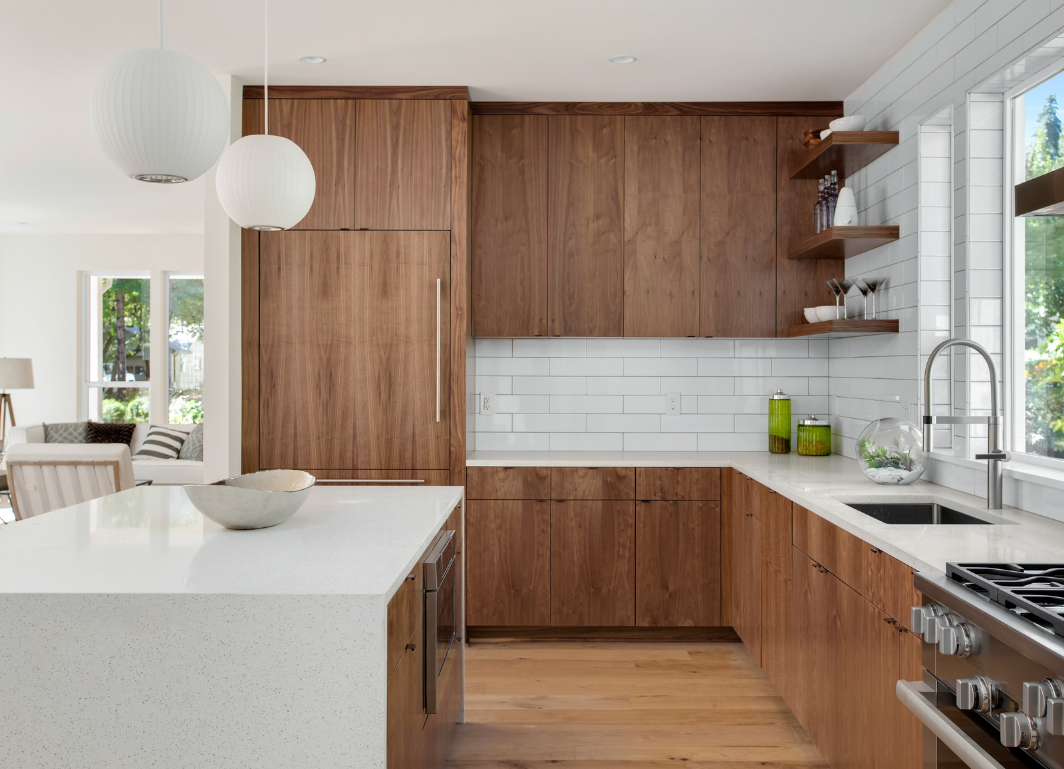
Pick the right cabinetry and you've made a good kitchen. Pick the right worktop and you've made it last. Worktops live with more daily abuse than any other surface in the house, water, heat, knives, red wine, weight, so the material matters more than the colour swatch suggests. This guide compares the three materials almost every Glasgow kitchen decision comes down to.
Quartz
Engineered stone, roughly 90% crushed natural quartz bound with resin and pigments, pressed into slabs. Brands like Silestone, Caesarstone, Compac and Unistone dominate the UK market. Looks like natural stone, behaves better.
Pros
- Effectively non-porous, wine, oil and turmeric don't stain
- Doesn't need sealing, ever
- Very hard, scratches only with serious effort
- Huge colour range, including consistent whites that natural marble can't deliver
- Joints can be near-invisible with colour-matched resin
Cons
- Not heat-proof, a hot pan straight from the hob can scorch the resin. Always use a trivet.
- Heavy, needs a strong base run and a two-to-four person lift to install
- Can chip on a hard edge if hit with something heavy
- Can't be repaired in situ if seriously damaged
Price (typical, installed)
£400–£700 per linear metre for mid-range slabs. Premium ranges push higher. Templating, fabrication and installation are usually included in the quoted figure.
Best for
Family kitchens that take heavy daily use, modern handleless designs where a seamless surface matters, and homeowners who'd rather not think about worktop maintenance.
Laminate
A high-density chipboard or MDF core wrapped in a printed decorative layer with a hard-wearing top film. The technology has moved on enormously, modern laminate from manufacturers like Egger, Bushboard and Duropal is genuinely good. The cheap glossy stuff from twenty years ago has given the category an unfair reputation.
Pros
- By far the cheapest option per metre
- Light, easy to fit, quick lead times
- Huge range of finishes, including extremely convincing stone and timber effects
- Warm to the touch compared with stone
- Quiet, dishes don't clatter the way they do on quartz
Cons
- Water is the enemy, if it gets into a seam (around the sink, especially) the chipboard core swells and can't be repaired
- Visible joints on long runs unless mitred
- Square-edged "stone effect" worktops can still feel like laminate up close
- Surface scratches with sharp knives; doesn't recover
Price (typical, installed)
£40–£120 per linear metre for the worktop itself, plus fitting. A whole tenement-kitchen worktop in laminate often comes in under £600 supplied.
Best for
Tighter budgets, rental properties, or any project where the spend is better directed at cabinetry, appliances or structural changes. Also a perfectly good choice in a light-use kitchen.
Solid wood
Real timber, typically oak, walnut or iroko, finger-jointed from staves and oiled. Honest, characterful, and ages beautifully if you look after it.
Pros
- Genuinely warm look and feel, quartz and laminate can't replicate it
- Scratches and dents can be sanded out and re-oiled, repairable, unlike either alternative
- Improves with age and use, gathers character
- Suits Shaker, in-frame and traditional kitchens beautifully
- Mid-priced, between laminate and quartz
Cons
- Needs oiling, properly once or twice in the first month, then every 6–12 months for life
- Vulnerable to standing water, particularly around the sink and dishwasher vent
- Stains darken into the timber if not wiped quickly
- Not ideal for cooks who don't want to maintain a surface
Price (typical, installed)
£150–£300 per linear metre depending on species and thickness.
Best for
Period properties (Victorian villas, traditional tenements), Shaker and in-frame kitchens, and households that genuinely will keep up with the oiling.
Side-by-side summary
- Lowest cost: laminate.
- Lowest maintenance: quartz.
- Most repairable: solid wood.
- Most heat-resistant: solid wood (with trivets) or sintered stone (a step beyond quartz).
- Most consistent appearance: quartz.
- Best for resale: quartz in a family home; in-frame kitchens often suit solid wood.
What about Dekton, Neolith, marble and granite?
Sintered stone (Dekton, Neolith) is the premium step beyond quartz, heat-proof, UV-stable, extremely durable, and priced accordingly (often 30–60% above quartz). Marble is gorgeous and will stain, better as an island piece than a working run. Granite has been largely overtaken by quartz in Scotland for visual reasons (colour movement) and cost, we still spec it occasionally on request.
What to do next
For everything Glasgow Kitchen Fitters includes in a worktop spec, sinks, upstands, splashbacks, sealing, see Worktops & Splashbacks. For where worktops sit in the overall budget, see our cost guide.